Buckinghamshire housing market
How can planning reform create opportunities for Buckinghamshire to deliver homes where they are needed most?
- Planning reform could unlock additional supply beyond the Local Plan, especially given Buckinghamshire is now delivering just 36% of its new annual housing target.
- Selective grey belt and station-adjacent sites offer the greatest opportunity in the higher-value and more constrained markets in South Buckinghamshire.
- Successful sites will match product to local demand, from premium family housing and downsizer homes to rental and affordable options. Despite being a unitary authority, the housing market across Buckinghamshire is anything but unitary. High-value towns and villages in the south, such as Gerrards Cross, Beaconsfield and the Chalfonts, see values approaching £700psf, whereas parts of central Aylesbury are under £300psf.
Future housing delivery, as identified in Buckinghamshire’s Local Plan, has focused primarily on high-density developments within the north of the county around Aylesbury, Winslow and Buckingham, with no Green Belt development. But these are not necessarily the areas with the greatest affordability pressures, best connectivity and highest market capacity.
South Buckinghamshire is where affordability stress is greatest, but also where constraints are highest. Green Belt, Chilterns National Landscape and flood risk covers around half the county. These constraints, alongside CIL, S106, BNG and SANG, are restricting opportunities in the south.
But new planning policies in the National Planning Policy Framework (NPPF) have the potential to create opportunities beyond the Local Plan. The ‘Golden Rules’ provide a mechanism to allow development on Green Belt, particularly grey belt sites, while providing community benefits such as higher levels of affordable housing, improved infrastructure and accessible green space.
Relying solely on development in the north risks missing important opportunities to improve affordability in the highest demand markets.
There is also an opportunity to take advantage of the transport connections which drive demand in the south of the county by densifying development around train stations. South Buckinghamshire is heavily reliant on its commutable distance to London – since 2024, 73% of working buyers purchasing through Savills in Amersham and Beaconsfield have been commuting to London.
Timing matters
These are important changes for the county to capitalise on at a time when viability has worsened, delivery has started to fall, and housing targets have increased.
Historic housing delivery has broadly kept up with the target set in the Local Plan (2024-2030), averaging just under 2,500 homes built every year over the last five years. However, delivery has very much slowed in the last two years from a peak of 3,750 in the year to March 2023 to just 1,580 in the year to March 2025. This reflects challenges felt nationally around viability, planning delays, material cost inflation and lower levels of buyer demand. But at the same time, the target for delivery, as set in the Standard Method, has increased to 4,300 homes a year, meaning that just 36% of this target was met in the year to March 2025.
Affordable housing delivery has likewise been strong in the past but has started to slow. Tenure has also shifted from social rent and Affordable Home Ownership to shared ownership and affordable rent, at a time when affordability has worsened.
Whilst the Local Plan has identified sites to meet this housing need, relying solely on development in the north risks reinforcing an imbalanced spatial strategy and missing important opportunities to identify additional sources of supply that will improve affordability in the highest demand markets.
What are the opportunities?
Almost half of Buckinghamshire is constrained by Green Belt — an important designation which protects wildlife, access to the countryside, improves air quality and limits urban sprawl.
While the Local Plan does not currently allocate supply for Green Belt release, there are a number of grey belt sites which do not meet these conditions as they are lower quality, underutilised or previously developed.
There are 208 provisional grey belt sites (shown in yellow on the map) within the Green Belt which are partially constrained but do not contribute to issues such as urban sprawl, merging towns or preserving character and heritage.
There are then an additional 33 grey belt sites (shown in green) which are not constrained and do not provide a strong contribution to the Green Belt.
These could provide an important opportunity to spread development more widely across the county, ease housing constraints in the south and contribute positively to local communities while addressing housing need through the ‘Golden Rules’.
Platform potential
The opening of East West Rail, and a new station at Winslow, is a genuine opportunity for Buckinghamshire to take advantage of its strategic location in the Oxford-Cambridge knowledge arc. It is unsurprising, therefore, that Winslow has been identified as a key area for development within the Local Plan.
But within the new NPPF, a ‘default yes’ would also be given to proposals which develop land around key stations (shown in brown on the map). The stations should be located within one of the top 80 Travel to Work Areas by GVA and have at least two trains per hour in any direction. Developable land is considered to be within a 'reasonable walking distance' which is represented by an 800m radius.
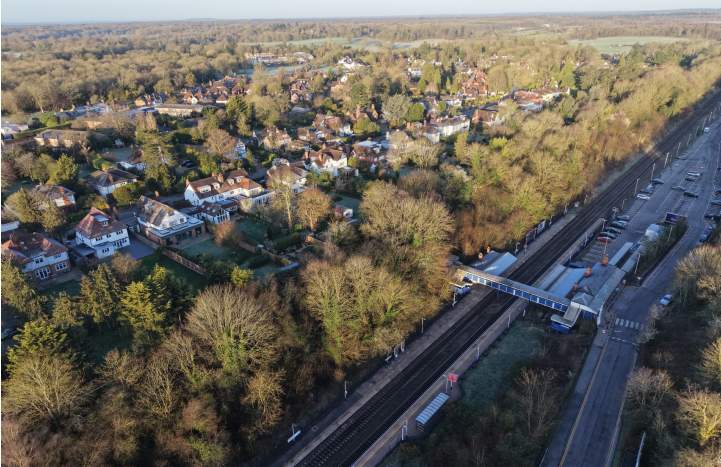
Fourteen stations within Buckinghamshire meet these requirements. In the more rural parts of the north, such as Cheddington and Haddenham & Thame Parkway, a higher proportion of land within the 800m radius is developable. But there are still significant opportunities for development around key commutable stations in the centre and south, like Seer Green & Jordans – one of the most expensive markets in the county.
Strategic release of underutilised grey belt and development around train stations provides potential to boost housing delivery.
The more flexible approach in the NPPF to density, from 40–50 dwellings per hectare to 35–45, also allows a more deliverable method to meet market demand for these highly desirable sites in the south.
But the question remains whether these opportunities stack up against viability in the current market – key to this will be delivering a range of housing options to meet a variety of housing needs.
Housing demand
Reflecting the vast range of house prices across Buckinghamshire, there is also diversity in the types of households across the county. In particular, there is a disparity between those moving to Buckinghamshire and those already resident.
Typically, those already resident in south Buckinghamshire are older, wealthier homeowners. The median income is just over £90,000, with 22% of households earning over £150,000 – compared to just 6% across the South East. Over 45% of
households are aged over 60, and 70% of households are adults without children – signifying an opportunity for more downsizer product.
By contrast, north Buckinghamshire is generally less affluent and has a higher concentration of families. The median income for residents is £65,000, and only 35% of households are aged over 60. While residents in Buckinghamshire are most likely to have the highest affluence classification – namely, Lavish Lifestyles, Pension Prosperity and Upmarket Commuters – movers to the county are more likely to be slightly lower affluence and more likely to be families, but still with sizeable incomes.
For movers specifically into new build in the south, 21% are classified as Lavish Lifestyles – high-wealth residents with generous incomes, assets and the most expensive homes.
There is a distinct lack of middle and lower income families moving into Buckinghamshire, suggesting there are limited options for these households.
These buyers are typically purchasing at small bespoke developments in the most expensive villages. In the north, these types of households only account for 4%. There is also a sizeable proportion of Upmarket Commuters moving to new build across the county – signifying strong demand for potential development around stations.
Missing markets
But there is a distinct lack of middle-income families moving into Buckinghamshire, particularly in the south. These households, classified as New Beginnings and ValueSeeking Families, are more likely to buy smaller new build houses on the outskirts of communities. This suggests there are very limited options for younger families and firsttime buyers in the current market. Likewise, the lack of low-income households moving to the county suggests there are not enough affordable housing options.
But there is a high proportion of High-Flying Metropolitans moving to all parts of the county, and accounting for a much higher proportion than residents. These are young professionals with good salaries, likely living in flats in the private rental market. The high house prices, particularly in south Buckinghamshire, present a significant barrier to home ownership for younger households.
There could, therefore, be more opportunity for purpose-built rented development. Currently, there are just four Build to Rent schemes across the county, with three of them multifamily flat developments. But single-family houses could also provide a more diverse product for a range of households, particularly in the markets most constrained by affordability.
Opening up delivery more broadly throughout the county beyond the sites identified in the Local Plan could provide a more balanced and deliverable housing strategy beyond just meeting the housing target. This would ease pressures in the south alongside creating opportunities in the north and, most importantly, deliver a range of options and price points for Buckinghamshire households.